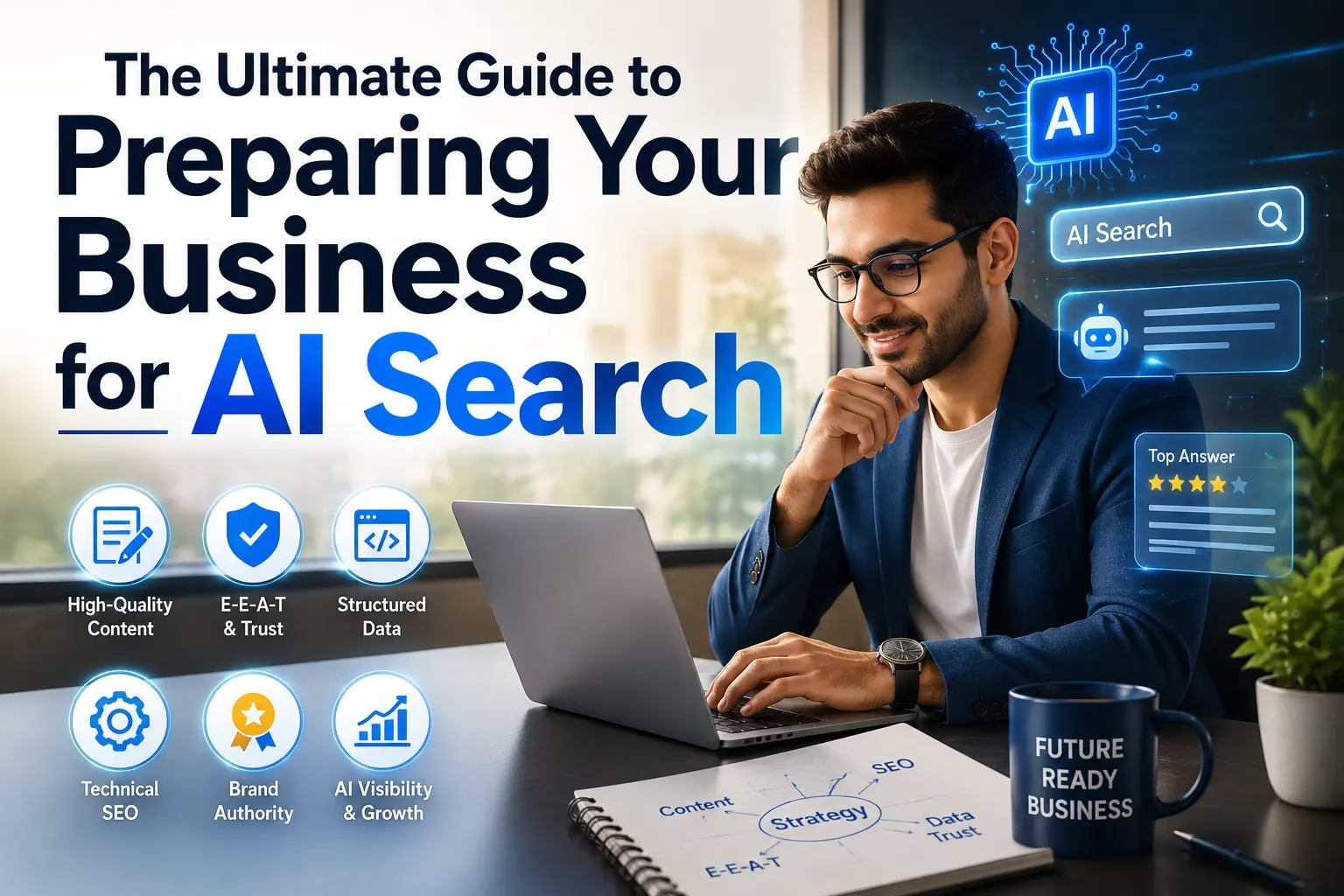
The way people search for information online is undergoing one of the biggest transformations since the launch of Google Search. For years, businesses have focused on traditional Search Engine Optimization (SEO) to improve rankings, increase website traffic, and generate leads. While these strategies remain valuable, the rapid adoption of Artificial Intelligence (AI) in search has introduced a new reality. Today, millions of users are turning to AI Search platforms like ChatGPT, Google AI Mode, Google AI Overviews, Gemini, Microsoft Copilot, Claude, and Perplexity AI to get instant, conversational answers instead of scrolling through pages of search results.
Unlike traditional search engines that display a list of websites based primarily on keywords and backlinks, AI search engines analyze user intent, understand context, and generate direct responses by gathering information from multiple trusted sources. This means your business may no longer compete solely for the top position on Google—it now competes to become one of the trusted sources that AI assistants reference when answering users’ questions.
For businesses of every size, this shift presents both a challenge and an incredible opportunity. Companies that continue relying only on outdated SEO practices risk losing visibility as AI-generated answers become more common. On the other hand, businesses that invest in AI Search Optimization can strengthen their online authority, reach highly qualified audiences, and build lasting trust with potential customers. AI search rewards brands that demonstrate expertise, publish accurate and helpful content, maintain technically optimized websites, and establish a credible digital presence across multiple platforms.
Preparing for AI Search is about much more than adding a few new keywords to your website. It requires a comprehensive strategy that combines technical SEO, high-quality content, structured data, E-E-A-T (Experience, Expertise, Authoritativeness, and Trustworthiness), brand reputation, customer reviews, and consistent online engagement. AI systems evaluate your entire digital footprint—not just a single webpage—to determine whether your business deserves to be recommended.
As AI-powered search continues to evolve in 2026 and beyond, customer expectations are changing as well. Users now expect fast, personalized, and reliable answers to their questions. Businesses that consistently provide valuable information, solve customer problems, and maintain trustworthy online profiles are far more likely to be featured in AI-generated responses. This increased visibility can lead to stronger brand recognition, higher-quality website traffic, improved conversion rates, and long-term business growth.
Whether you own a small local business, an eCommerce store, a B2B company, a healthcare practice, a real estate agency, or a global enterprise, preparing for AI Search is no longer optional—it is an essential part of a future-ready digital marketing strategy. The organizations that adapt early will gain a competitive advantage, while those that ignore this shift may find it increasingly difficult to reach their target audience through organic search alone.
In this comprehensive guide, you’ll learn what AI Search is, why it matters for your business, how AI search engines determine which brands to recommend, and the practical strategies you can implement today to improve your visibility across AI platforms. From optimizing your website and creating people-first content to building brand authority and monitoring AI search performance, this guide provides a step-by-step roadmap to help your business thrive in the new era of AI-powered search.
What Is AI Search?
AI Search is a new generation of search technology that uses Artificial Intelligence (AI) to understand the meaning, context, and intent behind a user’s query instead of simply matching keywords. Unlike traditional search engines that present a list of web pages, AI Search analyzes information from multiple trusted sources and generates clear, conversational, and personalized answers in real time.
Instead of searching for keywords like “best digital marketing agency” and browsing through several websites, users can ask detailed questions such as “Which digital marketing agency is best for a small business with a limited budget?” AI-powered search tools understand the complete question, evaluate reliable information from across the web, and provide a summarized answer with relevant recommendations.
This shift is transforming how people discover businesses, products, and services. AI Search focuses on delivering accurate, context-aware responses that help users find solutions faster, making the search experience more interactive and efficient.
How AI Search Differs from Traditional Search
Traditional search engines primarily rank websites based on factors such as keywords, backlinks, page authority, and technical SEO. Users then need to click through multiple links to find the information they need.
AI Search takes a different approach by:
- Understanding the intent behind a user’s question.
- Analyzing multiple trusted sources simultaneously.
- Summarizing information into a single, conversational response.
- Providing personalized and context-aware recommendations.
- Answering follow-up questions naturally without requiring a new search.
As a result, businesses are no longer competing only for the #1 ranking on Google—they are competing to become a trusted source that AI assistants choose to reference.
Popular AI Search Platforms
Several AI-powered search platforms are changing how users access information, including:
- ChatGPT Search
- Google AI Mode
- Google AI Overviews
- Google Gemini
- Microsoft Copilot
- Perplexity AI
- Claude AI
These platforms combine large language models with web information to provide users with fast, reliable, and conversational answers.
How AI Search Works
When a user asks a question, AI Search follows a series of intelligent steps:
- Understands User Intent – AI identifies what the user is really asking, even if the wording is complex or conversational.
- Searches Multiple Reliable Sources – It gathers relevant information from trusted websites, business profiles, articles, and other authoritative resources.
- Evaluates Credibility – AI considers factors such as content quality, expertise, freshness, website authority, reviews, and trust signals.
- Generates a Comprehensive Answer – Instead of displaying only links, AI creates a summarized response that directly addresses the user’s question.
- Supports Follow-Up Conversations – Users can ask additional questions, and AI remembers the context to provide more relevant answers.
Why AI Search Matters for Businesses
The rise of AI Search is changing digital marketing and SEO strategies. Businesses that optimize only for traditional search rankings may miss opportunities to appear in AI-generated responses.
To improve visibility in AI Search, businesses should focus on:
- Publishing high-quality, people-first content.
- Demonstrating Experience, Expertise, Authoritativeness, and Trustworthiness (E-E-A-T).
- Optimizing website performance and technical SEO.
- Using structured data (Schema Markup).
- Building a strong online reputation through reviews and brand mentions.
- Keeping content accurate, up-to-date, and comprehensive.
The Future of AI Search
AI Search is becoming the preferred way for many users to find information because it delivers faster, more relevant, and more personalized answers. As AI technology continues to evolve, businesses that invest in AI Search Optimization (AISO) alongside traditional SEO will be better positioned to increase their online visibility, attract qualified leads, and stay competitive in the digital landscape.
In short, AI Search is not replacing SEO—it is reshaping it. Businesses that create trustworthy, user-focused content and build a strong digital presence will have the best chance of being recommended by AI-powered search platforms.
Why AI Search Is Changing Online Visibility
Artificial Intelligence is fundamentally changing how people discover information, products, and businesses online. For more than two decades, businesses have relied on traditional Search Engine Optimization (SEO) to rank higher on search engines like Google. Success was largely measured by achieving top positions on search engine results pages (SERPs), increasing website traffic, and generating conversions through organic clicks.
Today, that model is evolving rapidly. AI-powered search platforms such as ChatGPT Search, Google AI Mode, Google AI Overviews, Gemini, Microsoft Copilot, Claude, and Perplexity AI are changing the search experience by providing users with direct, conversational answers instead of simply displaying a list of links. This shift means that online visibility is no longer determined solely by keyword rankings—it now depends on how trustworthy, authoritative, and useful your business appears across the web.
From Search Results to Direct Answers
Traditional search requires users to enter a keyword, browse through multiple websites, compare information, and decide which result best answers their question. AI Search eliminates much of this process by delivering summarized, context-aware answers instantly.
For example, instead of searching for “best CRM software for small businesses” and reviewing several websites, a user can ask, “Which CRM is best for a small business with fewer than 20 employees?” AI analyzes trusted sources, compares options, and provides a direct recommendation.
This means businesses must optimize not only to rank well but also to become reliable sources that AI systems choose to reference.
AI Prioritizes Trust Over Rankings
Traditional SEO emphasizes factors such as keywords, backlinks, and page authority. While these signals are still important, AI Search goes further by evaluating the overall credibility of your business.
AI platforms consider factors such as:
- Content quality and accuracy
- Experience and expertise
- Authoritativeness within your industry
- Trustworthiness (E-E-A-T)
- Customer reviews and ratings
- Website security and performance
- Structured data (Schema Markup)
- Brand mentions across reputable websites
- Fresh and regularly updated content
Businesses with strong trust signals are more likely to be recommended by AI assistants than websites that rely solely on keyword optimization.
Users Are Searching More Naturally
One of the biggest reasons AI Search is transforming online visibility is the way people search. Instead of typing short keyword phrases, users now ask complete, conversational questions.
For example:
Traditional Search:
- Digital marketing agency
- Best SEO company
- Local SEO services
AI Search:
- Which digital marketing agency is best for a startup with a limited budget?
- How can I increase website traffic without spending heavily on ads?
- What is the best SEO strategy for a local business in 2026?
Businesses that create detailed, people-first content answering these real-world questions are more likely to appear in AI-generated responses.
AI Evaluates Your Entire Digital Presence
In traditional SEO, a single well-optimized webpage could rank highly for a specific keyword. AI Search takes a broader approach by assessing your complete online presence.
This includes:
- Your website
- Google Business Profile
- Customer reviews
- Social media activity
- Industry directories
- News mentions
- Guest articles
- Business citations
- Author profiles
- Educational resources
- Community discussions
The stronger and more consistent your digital footprint, the greater your chances of being recognized as a trustworthy source.
Brand Authority Matters More Than Ever
AI systems are designed to recommend businesses they consider credible and authoritative. Companies that regularly publish expert content, share original insights, earn positive customer reviews, and receive mentions from respected websites are more likely to gain visibility.
Building brand authority involves:
- Publishing in-depth blogs and guides
- Creating case studies and success stories
- Earning high-quality backlinks
- Participating in industry events
- Contributing expert opinions
- Maintaining accurate business information across platforms
Authority is becoming one of the strongest competitive advantages in AI Search.
Zero-Click Searches Are Increasing
AI-generated answers often provide users with the information they need without requiring them to visit multiple websites. This trend, known as zero-click search, is becoming more common.
While this may reduce some traditional website clicks, it creates a new opportunity for businesses to be featured as trusted sources within AI-generated responses. Being cited by AI can significantly improve brand recognition, credibility, and customer trust, even before a user visits your website.
Better User Experience Drives Higher Expectations
AI Search delivers:
- Faster answers
- Personalized recommendations
- Natural conversations
- Follow-up interactions
- Context-aware responses
As users become accustomed to these experiences, businesses must create content that is easy to understand, comprehensive, and genuinely helpful. Websites that prioritize user experience are more likely to earn AI recommendations.
AI Search Rewards Helpful Content
Unlike older SEO strategies that sometimes focused heavily on keyword density, AI Search rewards content that demonstrates genuine expertise and solves user problems.
Businesses should focus on creating:
- Comprehensive guides
- Step-by-step tutorials
- Frequently Asked Questions (FAQs)
- Industry insights
- Original research
- Case studies
- Comparison articles
- Educational resources
Helpful, accurate, and well-structured content has a much greater chance of being surfaced by AI systems.
The Competitive Landscape Is Changing
Businesses that adapt early to AI Search Optimization are positioning themselves for long-term success. Those that continue relying only on traditional SEO techniques may find it harder to maintain visibility as AI-powered search becomes the standard.
Organizations that combine technical SEO, high-quality content, structured data, strong brand authority, and exceptional user experience will be better equipped to compete in both traditional search engines and AI-powered search platforms.
Why AI Search Is Changing Online Visibility
Artificial Intelligence is fundamentally transforming how people discover information, products, and businesses online. For years, businesses relied on traditional search engines where achieving a high ranking on Google was the primary goal of SEO. Today, AI-powered platforms such as ChatGPT, Google AI Mode, Google AI Overviews, Microsoft Copilot, Gemini, Claude, and Perplexity AI are changing this experience by providing users with instant, conversational answers instead of simply displaying a list of websites.
Rather than encouraging users to click through multiple search results, AI systems summarize information from trusted sources and present the most relevant answer in seconds. This shift means businesses can no longer depend solely on keyword rankings to attract customers. Instead, they must establish themselves as reliable, authoritative, and helpful sources of information that AI platforms can confidently recommend.
Another major reason AI Search is changing online visibility is its ability to understand user intent rather than just matching keywords. Modern users ask detailed, natural-language questions like “Which digital marketing agency is best for a startup?” or “How can I improve my website’s SEO without increasing my marketing budget?” AI interprets the context behind these questions and delivers personalized responses. Businesses that create comprehensive, people-first content addressing real customer concerns are therefore more likely to be featured in AI-generated answers. This represents a shift from keyword-focused optimization to intent-driven content that genuinely helps users solve problems.
AI Search also evaluates a business’s entire digital presence rather than focusing on a single webpage. It considers factors such as website quality, content accuracy, E-E-A-T (Experience, Expertise, Authoritativeness, and Trustworthiness), customer reviews, structured data, brand mentions, social media activity, and overall online reputation. As AI continues to become a primary source of information, businesses that invest in building authority and trust across multiple digital channels will gain greater visibility, stronger brand recognition, and a competitive advantage in the evolving search landscape.
How AI Search Works
AI Search combines advanced artificial intelligence, natural language processing (NLP), machine learning, and large language models (LLMs) to understand user queries and provide meaningful answers. When a user enters a question, the AI first analyzes the intent behind the query instead of simply identifying keywords. It understands the context, meaning, and purpose of the question, allowing it to respond more naturally than traditional search engines. Once the intent is understood, the AI gathers relevant information from multiple trusted websites, business profiles, knowledge bases, news articles, and authoritative online sources.
After collecting information, AI Search evaluates the credibility of each source using various trust signals. These include content quality, website authority, structured data, user engagement, customer reviews, freshness of information, technical SEO, and E-E-A-T principles. Rather than copying content from a single webpage, AI compares information from different sources, identifies the most accurate and reliable details, and generates a concise, conversational response tailored to the user’s question. Many AI platforms also provide citations or links to original sources, allowing users to explore the topic further if needed.
One of the most powerful features of AI Search is its conversational capability. Users can ask follow-up questions without starting a new search because AI remembers the context of the previous conversation. This creates a more interactive and personalized search experience compared to traditional search engines. As AI technology continues to improve, businesses that produce trustworthy, well-structured, and comprehensive content will have a much higher chance of being referenced and recommended by AI-powered search platforms.
Why Businesses Must Prepare for AI Search
Preparing for AI Search is no longer a future consideration—it is a necessity for businesses that want to remain competitive in the digital marketplace. Consumer search behavior is changing rapidly as more people rely on AI assistants to find products, compare services, and make purchasing decisions. Instead of visiting several websites, users increasingly expect AI platforms to provide direct recommendations and trusted answers. If your business is not optimized for AI Search, it may become less visible to potential customers, even if your website ranks well in traditional search results.
Businesses that prepare for AI Search gain several long-term advantages. By creating high-quality, informative content, improving technical SEO, implementing structured data, earning positive customer reviews, and building strong brand authority, they increase their chances of appearing in AI-generated responses. This enhanced visibility not only drives more qualified traffic but also builds credibility and trust with potential customers. Being recommended by AI platforms can significantly influence purchasing decisions, making AI Search Optimization an important component of any modern digital marketing strategy.
Preparing for AI Search also helps businesses future-proof their online presence. As AI technologies continue to evolve, search engines will place even greater emphasis on expertise, trustworthiness, user experience, and content relevance. Companies that begin adapting today will be better positioned to benefit from these changes, while those that delay may struggle to compete for visibility. By integrating AI Search Optimization with traditional SEO, businesses can strengthen their digital presence, reach wider audiences, and achieve sustainable growth in 2026 and beyond.
12 Proven Ways to Prepare Your Business for AI Search
As AI-powered search platforms continue to reshape how users discover businesses online, companies need to go beyond traditional SEO practices. AI Search prioritizes trustworthy brands, high-quality content, technical excellence, and strong online authority when generating recommendations. Preparing your business for AI Search requires a comprehensive digital marketing strategy that focuses on providing value to users while making your website easy for AI systems to understand. By implementing the following proven strategies, you can improve your chances of being featured in AI-generated answers, increase brand visibility, and stay competitive in the evolving search landscape.
1. Create Helpful, People-First Content
The foundation of AI Search Optimization is creating content that genuinely helps your audience. Instead of writing solely for search engines, focus on answering real customer questions, solving problems, and providing actionable insights. Publish detailed blogs, how-to guides, tutorials, case studies, and FAQs that demonstrate expertise and deliver value. AI platforms are more likely to recommend content that is informative, accurate, and written with users in mind.
2. Demonstrate Experience and Expertise (E-E-A-T)
AI systems prioritize content created by experts and trusted sources. Showcase your experience by sharing real-world examples, customer success stories, original research, industry insights, certifications, and team expertise. Adding author biographies, company credentials, and evidence of practical knowledge helps establish Experience, Expertise, Authoritativeness, and Trustworthiness (E-E-A-T), increasing your credibility in AI-generated responses.
3. Optimize Your Website’s Technical SEO
A technically sound website helps AI systems crawl, understand, and index your content more effectively. Ensure your website loads quickly, is mobile-friendly, uses HTTPS security, has clean URL structures, and includes XML sitemaps and a properly configured robots.txt file. Regular technical audits can identify issues that may prevent search engines and AI platforms from accessing your content.
4. Implement Structured Data (Schema Markup)
Structured data helps search engines and AI platforms understand the context of your content. Add schema markup such as Organization, Local Business, Article, FAQ, Product, Review, Breadcrumb, and Person schemas to provide clear information about your website. Proper implementation of structured data improves content interpretation and increases the likelihood of appearing in AI-generated summaries and rich search results.
5. Build Brand Authority Across the Web
AI Search evaluates your overall online reputation, not just your website. Strengthen your brand authority by earning backlinks from reputable websites, publishing guest posts, participating in industry events, obtaining media coverage, and maintaining consistent business information across online directories. A strong digital presence signals credibility and improves the chances of your business being recommended by AI platforms.
6. Optimize Your Google Business Profile
For local businesses, an optimized Google Business Profile is essential. Keep your business information accurate and updated, including your address, phone number, website, business hours, services, and images. Encourage satisfied customers to leave reviews and respond professionally to feedback. A well-maintained profile improves local visibility and provides AI systems with trustworthy business information.
7. Publish Comprehensive, In-Depth Content
AI Search prefers content that thoroughly covers a topic instead of providing superficial information. Create pillar pages and long-form articles that include definitions, benefits, comparisons, step-by-step instructions, statistics, examples, visuals, and FAQs. Comprehensive content increases user engagement and positions your business as an authoritative resource.
8. Answer Frequently Asked Customer Questions
Users often interact with AI platforms by asking conversational questions. Identify the most common questions your customers ask and create dedicated FAQ sections, blog posts, or knowledge base articles that answer them clearly. Addressing user intent directly increases the likelihood of your content being selected by AI assistants.
9. Keep Your Content Fresh and Updated
Outdated information can reduce your credibility with both users and AI systems. Regularly review and update your existing content with new statistics, industry trends, recent examples, improved visuals, and current best practices. Fresh, accurate content demonstrates that your business remains active and committed to providing reliable information.
10. Strengthen Trust Signals
Trust is one of the most important ranking factors for AI Search. Display customer testimonials, verified reviews, industry certifications, awards, security badges, privacy policies, and clear contact information on your website. Transparent business practices and positive customer experiences increase your credibility and improve your chances of being recommended by AI-powered search platforms.
11. Expand Your Presence Beyond Your Website
AI systems gather information from multiple online sources. Establish a strong presence on platforms such as LinkedIn, Medium, Quora, Reddit, YouTube, Google Business Profile, and relevant industry directories. Consistent branding and valuable content across these platforms reinforce your authority and improve your digital footprint.
12. Monitor and Improve Your AI Search Visibility
AI Search Optimization is an ongoing process that requires continuous monitoring and refinement. Use tools such as Google Search Console, Google Analytics 4, Ahrefs, Semrush, Bing Webmaster Tools, and AI search platforms to evaluate your performance. Regularly analyze user behavior, identify content gaps, track keyword trends, and update your strategy based on changing AI search algorithms and customer needs.
AI Search vs Traditional Google Search
The way people search for information online has evolved dramatically over the past few years. Traditional Google Search has been the foundation of digital marketing and SEO for decades, helping users find relevant websites by displaying ranked search results based on keywords, backlinks, and various ranking factors. Users typically enter a search query, browse through multiple web pages, compare different sources, and then choose the website that best answers their questions.
AI Search, however, introduces a completely different approach. Instead of presenting a list of links, AI-powered platforms such as ChatGPT Search, Google AI Mode, Google AI Overviews, Gemini, Microsoft Copilot, Claude, and Perplexity AI understand the user’s intent, analyze information from multiple trusted sources, and generate a direct, conversational answer. This significantly reduces the time users spend searching and provides a more personalized, interactive experience.
For businesses, this means that ranking on the first page of Google is no longer the only objective. Companies must also build trust, demonstrate expertise, create comprehensive content, and establish a strong online reputation to increase their chances of being recommended by AI-powered search platforms. While traditional SEO remains important, AI Search Optimization is becoming equally essential for maintaining long-term online visibility.
AI Search vs Traditional Google Search Comparison
| Feature | Traditional Google Search | AI Search |
|---|---|---|
| Search Method | Displays a ranked list of websites based on search algorithms. | Generates direct, conversational answers using AI. |
| Primary Focus | Keywords, backlinks, page authority, and technical SEO. | User intent, content quality, trust, and expertise. |
| User Experience | Users browse multiple websites to find answers. | Users receive summarized answers instantly. |
| Content Evaluation | Individual web pages are ranked separately. | AI evaluates the credibility of your entire digital presence. |
| Search Queries | Short keyword-based searches such as “SEO agency.” | Natural language questions like “Which SEO agency is best for a small business?” |
| Ranking Factors | Keywords, backlinks, page speed, mobile optimization, and domain authority. | E-E-A-T, brand authority, structured data, reviews, fresh content, and user trust. |
| Results Format | Blue links, featured snippets, images, videos, and local listings. | Conversational summaries with recommendations and citations. |
| Click Requirement | Users usually click multiple websites to find information. | Many questions are answered without requiring multiple clicks. |
| Personalization | Limited personalization based on location and search history. | Highly personalized responses based on context and follow-up questions. |
| Conversation Support | Every search is treated as a separate query. | Supports ongoing conversations and remembers previous context. |
| Business Visibility | Depends mainly on website rankings. | Depends on overall brand authority and trustworthiness across multiple platforms. |
| Optimization Strategy | Traditional SEO focusing on rankings and keywords. | AI Search Optimization focusing on authority, trust, and helpful content. |
Final Thoughts
AI Search is no longer a futuristic concept—it is becoming the new standard for how people discover information, products, and businesses online. As AI-powered platforms like ChatGPT, Google AI Mode, Google AI Overviews, Gemini, Microsoft Copilot, Claude, and Perplexity AI continue to evolve, businesses must rethink their digital marketing strategies. Ranking on Google’s first page is still valuable, but it is no longer enough. Success now depends on becoming a trusted source that AI systems recognize, understand, and recommend.
Preparing your business for AI Search requires a holistic approach. It involves creating people-first content, demonstrating expertise, improving technical SEO, implementing structured data, building brand authority, earning positive customer reviews, and maintaining a consistent presence across the web. AI platforms reward businesses that provide accurate, comprehensive, and trustworthy information while delivering an exceptional user experience.
The businesses that invest in AI Search Optimization today will be better positioned to attract qualified leads, strengthen customer trust, and stay ahead of competitors in the rapidly changing digital landscape. Rather than replacing traditional SEO, AI Search builds upon it by emphasizing quality, credibility, and user intent. Combining both strategies will help businesses maximize their online visibility across search engines and AI-powered assistants.
As technology continues to advance, customer expectations will also continue to rise. Businesses that remain adaptable, consistently update their content, and prioritize delivering genuine value will not only improve their chances of being recommended by AI but will also build stronger, long-lasting relationships with their audience. The future of search belongs to brands that educate, inspire, and solve real customer problems—and the best time to prepare for that future is now.
Frequently Asked Questions (FAQs)
1. What is AI Search?
AI Search is an advanced search technology that uses artificial intelligence to understand user intent and provide direct, conversational answers instead of simply displaying a list of websites.
2. How is AI Search different from traditional Google Search?
Traditional Google Search ranks web pages based on keywords and SEO signals, while AI Search analyzes multiple trusted sources to generate personalized, context-aware answers for users.
3. Why should businesses prepare for AI Search?
Businesses should prepare for AI Search because more users are relying on AI assistants to discover products, services, and information. Optimizing for AI Search helps improve online visibility, brand authority, and lead generation.
4. Will AI Search replace traditional SEO?
No. AI Search is not replacing SEO; it is expanding it. Traditional SEO remains important, but businesses should also focus on AI Search Optimization by creating helpful content, improving technical SEO, and building trust.
5. What factors influence AI Search recommendations?
AI platforms consider several factors, including content quality, E-E-A-T (Experience, Expertise, Authoritativeness, and Trustworthiness), website performance, structured data, customer reviews, backlinks, brand mentions, and overall online credibility.
6. How can I optimize my website for AI Search?
You can optimize your website by publishing comprehensive, people-first content, improving page speed, implementing schema markup, maintaining technical SEO, updating content regularly, and building brand authority through reviews and quality backlinks.
7. Does structured data help with AI Search?
Yes. Structured data (Schema Markup) helps AI systems understand your website’s content more effectively, improving the chances of appearing in AI-generated summaries and search results.
8. Can small businesses benefit from AI Search Optimization?
Absolutely. Small businesses can compete effectively by creating valuable content, optimizing their Google Business Profile, earning positive customer reviews, and establishing expertise within their niche.
9. What are the best tools to monitor AI Search visibility?
Useful tools include Google Search Console, Google Analytics 4, Ahrefs, Semrush, Bing Webmaster Tools, Microsoft Clarity, Screaming Frog, and AI platforms like ChatGPT Search and Perplexity AI.
10. Is AI Search Optimization a one-time process?
No. AI Search Optimization is an ongoing process. Businesses should regularly update their content, monitor performance, improve technical SEO, and adapt their strategy as AI technologies and user behavior continue to evolve.
Author Bio
StubbSpire Team
The StubbSpire Team is a group of experienced digital marketing professionals dedicated to helping businesses grow through innovative online marketing strategies. With expertise in SEO, AI Search Optimization (AISO), Google Ads, Local SEO, Content Marketing, B2B Lead Generation, Social Media Marketing, and Website Optimization, the team creates practical, data-driven resources that help businesses improve their online visibility and generate sustainable growth.
At StubbSpire, we believe that the future of digital marketing lies in combining traditional SEO best practices with emerging AI-driven search strategies. Our mission is to help startups, small businesses, and enterprises adapt to the changing search landscape by creating high-quality, people-first content, improving technical performance, and building trusted online brands.
Through our blogs, guides, case studies, and industry insights, we simplify complex digital marketing concepts into actionable strategies that businesses can implement with confidence. Whether you’re looking to rank higher on Google, appear in AI-generated search results, generate qualified leads, or build a stronger online presence, the StubbSpire Team is committed to helping you achieve measurable, long-term success in the evolving world of AI-powered search.