In today’s highly competitive software industry, simply building a great product is no longer enough to achieve sustainable growth. Thousands of Software-as-a-Service (SaaS) companies launch every year, making it increasingly difficult to capture the attention of potential customers. This is where SaaS Lead Generation becomes one of the most critical components of a successful SaaS business strategy.
SaaS Lead Generation is the process of attracting, engaging, and converting potential customers into qualified leads who have a genuine interest in your software solution. Unlike traditional businesses that often rely on one-time purchases, SaaS companies depend on recurring subscriptions. This means consistently generating high-quality leads is essential for maintaining revenue growth, reducing customer acquisition costs, and increasing long-term profitability.
The SaaS buying journey is also unique. Most prospects don’t purchase software immediately after discovering it. Instead, they compare multiple solutions, read reviews, explore pricing, request product demos, and evaluate whether the software solves their specific business challenges. Because of this longer decision-making process, businesses need a well-planned SaaS Lead Generation strategy that nurtures prospects at every stage of the sales funnel.
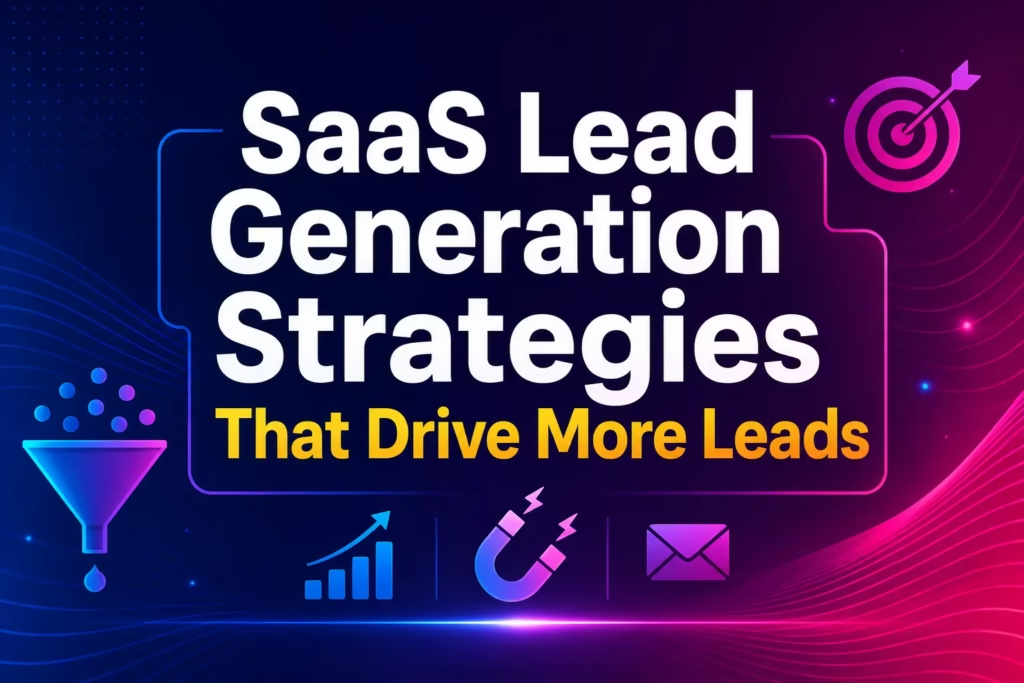
Modern SaaS Lead Generation combines several digital marketing channels to attract and convert potential customers. Search Engine Optimization (SEO) helps your website rank for high-intent keywords, while content marketing educates prospects through blogs, guides, case studies, and webinars. Google Ads and LinkedIn Ads generate immediate visibility among decision-makers, and email marketing nurtures leads until they are ready to subscribe. Marketing automation and customer relationship management (CRM) tools further streamline the entire lead nurturing process.
One of the biggest advantages of effective SaaS Lead Generation is its ability to attract highly targeted prospects rather than random website visitors. By identifying your Ideal Customer Profile (ICP), understanding buyer intent, and creating valuable content that answers customer questions, you can generate leads that are more likely to convert into paying subscribers. This targeted approach improves conversion rates, lowers acquisition costs, and increases customer lifetime value (CLV).
A successful SaaS Lead Generation strategy typically follows a structured funnel:
- Awareness: Prospects discover your software through search engines, social media, paid advertising, referrals, or industry publications.
- Interest: They consume valuable content such as blogs, comparison pages, videos, or webinars to understand your solution.
- Consideration: They sign up for newsletters, download resources, request demos, or start a free trial.
- Decision: Sales teams or automated workflows address objections, demonstrate value, and convert qualified leads into paying customers.
- Retention: Existing customers receive ongoing support, product updates, and educational resources, encouraging renewals and referrals.
Today’s buyers expect personalized experiences throughout this journey. Generic sales pitches are no longer effective. Instead, SaaS companies must provide relevant content, transparent pricing, social proof, customer success stories, and a seamless user experience across every touchpoint. Businesses that prioritize customer education and trust-building often outperform competitors that focus solely on aggressive sales tactics.
Data and analytics also play a vital role in SaaS Lead Generation. By monitoring metrics such as website traffic, lead conversion rate, cost per lead (CPL), customer acquisition cost (CAC), monthly recurring revenue (MRR), and customer lifetime value (CLV), businesses can continuously optimize their campaigns and improve return on investment. A data-driven approach ensures marketing budgets are spent efficiently while maximizing lead quality and sales opportunities.
As artificial intelligence (AI), automation, and predictive analytics continue to transform digital marketing, SaaS Lead Generation is becoming smarter and more efficient. AI-powered chatbots, personalized email campaigns, predictive lead scoring, and automated customer journeys enable businesses to engage prospects at the right time with the right message, increasing both conversions and customer satisfaction.
Ultimately, SaaS Lead Generation is not just about filling your sales pipeline with contacts—it’s about attracting the right audience, building trust, solving real business problems, and creating lasting customer relationships. Companies that invest in a strategic, SEO-driven, and customer-focused lead generation process are better positioned to achieve scalable growth, improve recurring revenue, and gain a competitive advantage in the rapidly evolving SaaS marketplace.
Why SaaS Lead Generation Matters in 2026
The SaaS industry is more competitive than ever in 2026. With thousands of software solutions available across nearly every business category, customers have countless options to choose from. Simply launching a great product is no longer enough to attract subscribers. Businesses need a consistent and strategic SaaS Lead Generation process to connect with the right audience, build trust, and convert prospects into loyal customers.
Today’s buyers are also more informed than ever. Before purchasing software, they research online, compare competitors, read customer reviews, watch product demonstrations, and seek recommendations from industry experts. This means SaaS companies must establish a strong digital presence and provide valuable information throughout the buyer’s journey. An effective SaaS Lead Generation strategy ensures your business appears where potential customers are searching and offers the resources they need to make confident purchasing decisions.
1. Rising Competition Requires Better Lead Generation
Every year, new SaaS startups enter the market, increasing competition across industries such as CRM, HR software, cybersecurity, accounting, healthcare, education, and project management. Standing out requires more than paid advertisements—it demands a comprehensive SaaS Lead Generation strategy that combines SEO, content marketing, social media, email marketing, webinars, and paid campaigns.
Companies that consistently generate qualified leads gain a significant advantage over competitors that rely only on referrals or outbound sales.
2. AI Is Changing How Customers Search
In 2026, AI-powered search engines and conversational platforms like ChatGPT, Google AI Overviews, and other generative search tools are influencing how users discover software solutions. Buyers now expect direct answers instead of browsing dozens of websites.
To remain visible, SaaS businesses must optimize content for both traditional search engines and AI-driven search experiences. Publishing helpful, authoritative, and experience-based content improves visibility and supports long-term SaaS Lead Generation.
3. Organic Traffic Reduces Customer Acquisition Costs
Paid advertising can generate leads quickly, but costs continue to rise every year. Businesses that depend solely on paid campaigns often face increasing Customer Acquisition Costs (CAC).
SEO-driven SaaS Lead Generation helps attract qualified visitors organically, reducing dependence on paid advertising while generating consistent leads over time. High-ranking blog posts, comparison pages, product guides, and educational resources continue bringing prospects long after they’re published.
4. Longer Buying Cycles Demand Lead Nurturing
Unlike impulse purchases, SaaS products often involve multiple stakeholders and careful evaluation. Decision-makers may compare several vendors, request product demonstrations, consult internal teams, and review pricing before making a purchase.
A structured SaaS Lead Generation strategy nurtures prospects through email campaigns, case studies, webinars, product updates, and personalized communication until they’re ready to subscribe.
5. Subscription Businesses Depend on Continuous Growth
Because SaaS companies operate on recurring revenue models, they must consistently acquire new customers while retaining existing ones. A slowdown in lead generation can directly affect Monthly Recurring Revenue (MRR) and overall business growth.
Consistent SaaS Lead Generation creates a healthy sales pipeline that supports predictable revenue and long-term scalability.
6. Better Lead Quality Improves Sales Performance
Generating a large number of leads isn’t enough. Sales teams perform better when they receive qualified prospects who genuinely need the product.
Modern SaaS Lead Generation focuses on identifying the Ideal Customer Profile (ICP), understanding buyer intent, and using lead scoring to prioritize prospects most likely to convert. This improves conversion rates and shortens the sales cycle.
7. Data-Driven Marketing Delivers Better Results
Marketing platforms now provide detailed insights into customer behavior, allowing SaaS businesses to optimize campaigns continuously.
Tracking metrics such as:
- Website traffic
- Lead conversion rate
- Customer Acquisition Cost (CAC)
- Cost Per Lead (CPL)
- Customer Lifetime Value (CLV)
- Monthly Recurring Revenue (MRR)
helps businesses refine their SaaS Lead Generation strategy and maximize return on investment.
8. Personalized Experiences Increase Conversions
Today’s customers expect personalized recommendations, targeted email campaigns, customized landing pages, and relevant product demonstrations.
AI-powered marketing automation enables SaaS companies to deliver personalized experiences at scale, increasing engagement and improving conversion rates throughout the customer journey.
9. Trust Is a Major Competitive Advantage
Before choosing a SaaS provider, customers look for reviews, testimonials, case studies, certifications, and thought leadership content.
An effective SaaS Lead Generation strategy builds credibility through educational blogs, customer success stories, industry reports, and transparent communication. Strong trust signals help reduce purchase hesitation and encourage more conversions.
10. Sustainable Growth Depends on a Reliable Lead Pipeline
Successful SaaS companies don’t rely on occasional marketing campaigns. They build repeatable systems that continuously generate qualified leads through SEO, content marketing, paid advertising, referral programs, partnerships, webinars, and email marketing.
A reliable SaaS Lead Generation pipeline creates predictable growth, improves forecasting, supports sales teams, and allows businesses to scale confidently in an increasingly competitive digital marketplace.
Know Your Ideal Customer Profile (ICP)
One of the most important steps in building a successful SaaS Lead Generation strategy is identifying your Ideal Customer Profile (ICP). Without a clear understanding of who your ideal customers are, your marketing campaigns may attract visitors who have little interest in your software, resulting in low conversion rates and wasted marketing budgets.
An Ideal Customer Profile (ICP) is a detailed description of the type of business or individual that gains the most value from your SaaS product. It helps your marketing and sales teams focus on high-quality prospects who are more likely to become long-term, paying customers. Rather than trying to appeal to everyone, an ICP ensures your SaaS Lead Generation efforts target the right audience with the right message at the right time.
What Is an Ideal Customer Profile (ICP)?
An Ideal Customer Profile outlines the characteristics of your perfect customer based on data, research, and existing successful clients. It includes details such as:
- Industry or niche
- Company size
- Business location
- Annual revenue
- Number of employees
- Decision-makers and job titles
- Common business challenges
- Software requirements
- Budget range
- Buying behavior
- Growth stage
For example, if your SaaS product is a project management platform, your ideal customers might be medium-sized IT companies with 50–500 employees, where project managers and operations directors are responsible for purchasing software.
Why an ICP Is Essential for SaaS Lead Generation
Knowing your ICP enables you to create more targeted marketing campaigns that attract qualified leads instead of random website visitors. When your content, advertisements, and landing pages address the specific pain points of your audience, prospects are more likely to engage with your brand and convert into customers.
A clearly defined ICP helps you:
- Improve lead quality
- Increase conversion rates
- Reduce Customer Acquisition Cost (CAC)
- Shorten the sales cycle
- Create personalized marketing campaigns
- Improve customer retention
- Increase Customer Lifetime Value (CLV)
Ultimately, understanding your ICP makes your SaaS Lead Generation strategy more efficient and cost-effective.
How to Build Your Ideal Customer Profile
1. Analyze Your Best Existing Customers
Start by reviewing your current customer base. Identify customers who:
- Stay subscribed for a long time
- Generate the highest revenue
- Use your product regularly
- Provide positive reviews and referrals
Look for common characteristics among these customers to identify patterns.
2. Understand Customer Pain Points
Every successful SaaS product solves a problem. Identify the challenges your ideal customers face before they discover your software.
Ask questions like:
- What problems are they trying to solve?
- What processes consume too much time?
- Which manual tasks could be automated?
- What business goals are they trying to achieve?
Your SaaS Lead Generation content should clearly explain how your software solves these issues.
3. Identify Decision-Makers
In B2B SaaS, purchasing decisions are rarely made by one person. Depending on your product, key decision-makers may include:
- CEOs
- Founders
- Marketing Managers
- HR Managers
- IT Directors
- Operations Managers
- Finance Teams
- Procurement Specialists
Knowing who influences the buying decision helps you create messaging that speaks directly to their priorities.
4. Segment Your Audience
Not every customer has the same needs. Divide your audience into segments based on factors such as:
- Industry
- Company size
- Job role
- Budget
- Product use case
- Business goals
Audience segmentation allows you to personalize emails, ads, landing pages, and blog content, improving your SaaS Lead Generation results.
5. Research Competitors
Study your competitors to understand who they target and how they position their products. Analyze:
- Customer reviews
- Pricing pages
- Case studies
- Social media engagement
- Content topics
This research can reveal gaps in the market and opportunities to differentiate your SaaS offering.
Use Data to Refine Your ICP
Your Ideal Customer Profile should evolve as your business grows. Use tools such as:
- Google Analytics
- Google Search Console
- CRM platforms
- Marketing automation software
- Customer surveys
- Product usage analytics
Review performance regularly to understand which audiences generate the highest-quality leads and revenue. Continuously updating your ICP keeps your SaaS Lead Generation strategy aligned with changing customer needs.
Common Mistakes to Avoid
Many SaaS businesses reduce the effectiveness of their SaaS Lead Generation by making these common mistakes:
- Trying to target everyone instead of a specific audience.
- Building campaigns based on assumptions rather than customer data.
- Ignoring customer feedback and product usage insights.
- Failing to update the ICP as markets and customer needs evolve.
- Creating generic content that doesn’t address industry-specific challenges.
Avoiding these mistakes helps you attract more qualified prospects and improve marketing ROI.
Build a High-Converting SaaS Website
Your website is the foundation of your SaaS Lead Generation strategy. It is often the first interaction potential customers have with your brand, and within just a few seconds, they’ll decide whether to stay or leave. A high-converting SaaS website doesn’t just look modern—it clearly communicates your product’s value, builds trust, and guides visitors toward taking action, whether that’s signing up for a free trial, booking a demo, or requesting more information.
In 2026, buyers expect fast-loading websites, intuitive navigation, personalized experiences, and helpful content before they commit to a software solution. If your website is difficult to navigate, slow to load, or fails to explain how your product solves customer problems, you’ll lose valuable leads to competitors. That’s why optimizing your website is one of the most effective ways to improve SaaS Lead Generation and increase conversions.
Create Valuable Content That Attracts Qualified Leads
Content marketing is one of the most effective ways to improve SaaS Lead Generation because today’s buyers prefer to educate themselves before speaking with a sales representative. By creating informative, relevant, and solution-focused content, you can attract potential customers who are actively searching for answers to their business challenges. Publish blog posts, product tutorials, comparison articles, case studies, whitepapers, eBooks, webinars, videos, and industry reports that address your audience’s pain points and demonstrate how your software provides the solution. Instead of focusing only on promotional content, prioritize educational resources that build trust and establish your company as an industry authority. Adding customer success stories, FAQs, and practical guides can further increase engagement and encourage visitors to take the next step, such as signing up for a free trial or requesting a demo. High-quality content not only improves search engine rankings but also generates qualified leads that are more likely to convert into paying customers.
Leverage SEO to Increase Organic SaaS Lead Generation
Search Engine Optimization (SEO) remains one of the most cost-effective strategies for SaaS Lead Generation because it helps your website attract qualified traffic without relying solely on paid advertising. Start by researching high-intent keywords your target audience uses when searching for software solutions. Optimize your website’s landing pages, blog posts, product pages, meta titles, meta descriptions, headings, and internal links around these keywords. Create content that satisfies user intent and follows Google’s E-E-A-T (Experience, Expertise, Authoritativeness, and Trustworthiness) guidelines. Technical SEO is equally important—ensure your website loads quickly, is mobile-friendly, uses secure HTTPS connections, and provides an excellent user experience. Building high-quality backlinks from reputable websites and regularly updating your content will further strengthen your search rankings. As your organic visibility grows, you’ll consistently attract prospects actively looking for solutions like yours, resulting in sustainable and scalable SaaS Lead Generation.
Use Paid Advertising to Scale Lead Generation
While SEO delivers long-term results, paid advertising helps accelerate SaaS Lead Generation by placing your software in front of high-intent audiences almost instantly. Platforms like Google Ads, LinkedIn Ads, Microsoft Ads, and Meta Ads allow you to target users based on search intent, industry, job title, company size, interests, and online behavior. Instead of driving paid traffic to your homepage, create dedicated landing pages with compelling headlines, clear value propositions, customer testimonials, and strong calls-to-action. Offer free trials, product demos, consultations, or downloadable resources to encourage conversions. Retargeting campaigns are particularly effective because they reconnect with visitors who previously interacted with your website but didn’t convert. Regularly monitor metrics such as click-through rate (CTR), conversion rate, cost per lead (CPL), and return on ad spend (ROAS) to optimize campaign performance. When managed effectively, paid advertising can significantly increase qualified leads and accelerate business growth.
Nurture Leads with Email Marketing & Marketing Automation
Not every prospect is ready to purchase immediately, which is why lead nurturing plays a vital role in successful SaaS Lead Generation. Email marketing allows you to stay connected with potential customers throughout their buying journey by providing relevant and personalized content. Instead of sending generic promotional emails, create automated workflows based on user behavior, such as downloading an eBook, signing up for a webinar, or starting a free trial. Share educational blog articles, case studies, feature updates, customer success stories, product tutorials, and exclusive offers to keep prospects engaged. Marketing automation platforms can segment audiences, personalize messages, score leads, and trigger follow-up emails at the right time. This consistent communication builds trust, addresses customer concerns, and increases the likelihood of converting leads into long-term subscribers while reducing the workload for your sales team.
Measure, Optimize, and Improve Your SaaS Lead Generation Strategy
A successful SaaS Lead Generation strategy requires continuous monitoring and improvement. Simply launching campaigns isn’t enough—you need to analyze performance data to understand what’s working and where adjustments are needed. Track important metrics such as website traffic, organic keyword rankings, conversion rates, customer acquisition cost (CAC), cost per lead (CPL), customer lifetime value (CLV), monthly recurring revenue (MRR), bounce rate, and demo bookings. Use tools like Google Analytics, Google Search Console, CRM software, and marketing automation platforms to gain actionable insights into customer behavior. Conduct A/B testing on landing pages, email subject lines, ad creatives, headlines, and call-to-action buttons to identify the highest-performing variations. Regular optimization based on real data ensures better marketing efficiency, higher conversion rates, and a stronger return on investment over time.
Common SaaS Lead Generation Mistakes to Avoid
Even well-designed marketing campaigns can fail if common mistakes are overlooked. One of the biggest errors in SaaS Lead Generation is trying to target everyone instead of focusing on a clearly defined Ideal Customer Profile (ICP). Generic messaging often attracts unqualified traffic that rarely converts. Another mistake is neglecting SEO and relying entirely on paid advertising, which can significantly increase customer acquisition costs over time. Many SaaS businesses also fail to create dedicated landing pages, use weak calls-to-action, or ask for too much information in lead capture forms, causing visitors to abandon the process. Ignoring email nurturing, failing to follow up with prospects, and not using marketing automation can result in missed sales opportunities. Additionally, businesses often overlook analytics, making it difficult to identify which campaigns generate the best results. By avoiding these mistakes and continuously refining your strategy, you can build a more effective SaaS Lead Generation system that consistently attracts qualified leads, improves conversions, and drives sustainable business growth.
Frequently Asked Questions (FAQs)
1. What is SaaS Lead Generation?
SaaS Lead Generation is the process of attracting, capturing, and converting potential customers who are interested in your software-as-a-service product through digital marketing strategies like SEO, content marketing, PPC, email marketing, and social media.
2. Which is the best SaaS Lead Generation strategy?
A combination of SEO, content marketing, Google Ads, LinkedIn marketing, email automation, and customer referrals delivers the best long-term SaaS Lead Generation results.
3. How can SEO improve SaaS Lead Generation?
SEO helps your SaaS website rank higher on search engines, bringing qualified organic traffic that converts into leads without ongoing advertising costs.
4. What are the most effective lead magnets for SaaS companies?
Free trials, product demos, eBooks, templates, webinars, case studies, ROI calculators, and checklists are among the most effective lead magnets.
5. How long does SaaS Lead Generation take?
Paid campaigns can generate leads immediately, while SEO and content marketing typically deliver sustainable results within 3–6 months.
6. Is Google Ads good for SaaS Lead Generation?
Yes. Google Ads can quickly generate high-intent leads when campaigns are optimized with the right keywords, landing pages, and conversion tracking.
7. Which metrics should SaaS businesses track?
Monitor website traffic, conversion rate, Cost Per Lead (CPL), Customer Acquisition Cost (CAC), Monthly Recurring Revenue (MRR), Customer Lifetime Value (LTV), and lead-to-customer conversion rate.
8. What is the biggest mistake in SaaS Lead Generation?
Focusing only on traffic instead of lead quality, ignoring customer intent, and failing to nurture prospects through email automation are common mistakes.
Final Thoughts
Successful SaaS Lead Generation is more than generating website traffic—it’s about attracting the right audience, building trust, and guiding prospects through every stage of the buyer’s journey. By combining SEO, content marketing, paid advertising, email automation, and data-driven optimization, SaaS businesses can create a predictable pipeline of qualified leads and sustainable revenue growth. Continuously testing, measuring, and refining your strategy will help you stay ahead of competitors and maximize your return on investment.
Author Bio
About StubbSpire Digital Marketing Agency
StubbSpire Digital Marketing Agency is a results-driven digital marketing company dedicated to helping SaaS businesses, startups, and B2B companies achieve sustainable online growth. With expertise in SaaS Lead Generation, SEO, Google Ads, content marketing, Local SEO, website development, and AI-powered marketing strategies, StubbSpire creates customized solutions that attract qualified leads, improve search engine rankings, and increase conversions.
By following Google’s latest E-E-A-T guidelines and leveraging data-driven marketing techniques, StubbSpire helps businesses build a strong online presence, generate high-quality leads, and maximize return on investment. Whether you’re looking to scale your SaaS business, improve organic visibility, or launch high-performing paid campaigns, StubbSpire Digital Marketing Agency provides practical, measurable, and growth-focused digital marketing solutions tailored to your business goals.