
If there is one question about digital marketing that keeps small business owners up at night, it is this: “Am I investing enough to grow, or am I just throwing money into an online black hole?”
As we navigate the business landscape of 2026, the stakes have never been higher. The days of treating online visibility as an optional line item are long gone. Today, Digital Marketing is the literal lifeblood of commercial growth, steering how small businesses get discovered, build trust, and outmaneuver enterprise competitors.
But here is the catch—there is no one-size-fits-all dollar amount. A local service provider, a scaling e-commerce store, and a B2B startup all require fundamentally different financial roadmaps.
Let’s cut through the fluff and look at the real, humanized data, benchmarks, and tactical breakdowns to determine exactly how much your small business should invest in Digital Marketing this year to maximize your return on investment (ROI).
The 2026 Golden Rule: The Percentage of Revenue Model
For years, the U.S. Small Business Administration and global financial consulting firms have thrown around a standard baseline: spend 7% to 10% of your gross revenue on marketing.
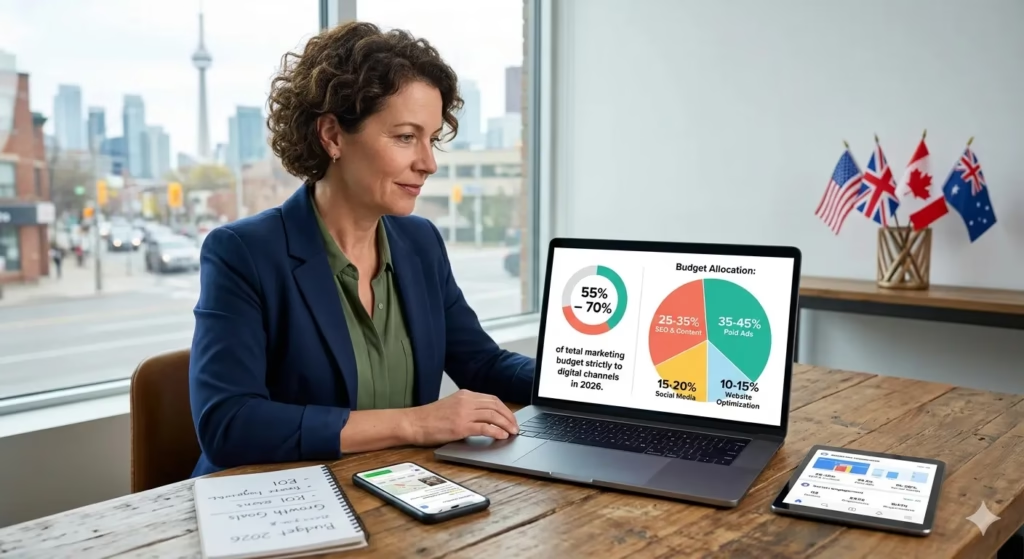
In 2026, that rule has evolved. Because consumers rely almost entirely on conversational AI discovery, localized search, and social proof, small businesses are now allocating 55% to 70% of their total marketing budget strictly to digital channels.
To make this practical, let’s look at how much you should spend based on your specific growth stage:
| Business Stage | Recommended % of Gross Revenue | Primary Strategic Focus |
| Startup / New Business | 12% – 20% | Brand awareness, aggressive lead generation, building a digital foundation. |
| Growing Small Business | 7% – 12% | Funnel optimization, market expansion, capturing high-intent search traffic. |
| Established Business | 5% – 7% | Customer retention, brand authority maintenance, local dominance. |
The Reality Check: If your small business is pulling in $500,000 annually and you are in a steady growth phase, a total digital spend of $35,000 to $50,000 per year ($3,000 to $4,000 a month) is the sweet spot to remain competitive without straining your operational cash flow.
Where Should the Money Go? Smart Budget Allocation
Throwing your entire budget into a single channel is a recipe for disaster. A healthy 2026 digital ecosystem requires a balanced mix of immediate wins and long-term asset building.
Here is how successful small businesses are breaking down their monthly dollar today:
1. Organic Search & Content Engine (25% – 35%)
Paid ads stop the second you stop paying for them. That is why smart businesses invest heavily in organic visibility. Partnering with an expert SEO company in London or securing premier SEO services Canada ensures that your business builds compounding value. When you rank natively on Google for high-intent keywords, your cost-per-lead drops dramatically over time.
2. Paid Advertising & Performance Marketing (35% – 45%)
This is your fast lever. Whether it’s Google Ads targeting users ready to buy right now or localized Meta ads, performance marketing keeps your pipeline full while your organic channels mature.
3. Social Media & Trust Building (15% – 20%)
Social media isn’t just for viral reels anymore; it’s a modern search engine. Consumers check your social profiles to see if you are legitimate, responsive, and active before making a purchase.
4. Website Infrastructure & Conversion Optimization (10% – 15%)
You can send millions of users to your site, but if it takes more than two seconds to load or looks outdated, they will bounce. Your website is your digital storefront—keep it flawless.
Navigating Global Markets: What Does Expertise Cost in 2026?
Because digital marketing is highly localized, your costs will shift depending on where your target audience lives and where you hire your talent. Small businesses are increasingly outsourcing to specialized regional agencies to get the highest level of expertise for their budget.
Here is a look at what it takes to scale effectively across major global markets this year:
The United States
The American market remains one of the most competitive spaces online. To stand out, working with an established digital marketing agency in USA is essential for navigating high cost-per-click (CPC) rates. For local brick-and-mortar setups, focusing heavily on SEO services for small business USA ensures you capture local “near me” searches. Pair this with the best social media marketing company USA to humanize your brand and capture visual-first buyers on Instagram and TikTok.
The United Kingdom
In the UK, consumer trust and precise local targeting dominate. Engaging a premier digital marketing agency UK helps businesses align with nuanced regional buyer behaviors. If you are operating out of or targeting England’s capital, collaborating with a dedicated SEO company in London is the gold standard for breaking through the noise of dense metropolitan competition, while structured social media marketing UK initiatives keep your audience engaged and loyal.
Canada
Canadian small businesses face unique geographical and demographic layouts. A full-service digital marketing company Canada can help bridge the gap between regional provinces. Growth here starts with a seamless online user experience, making a top-tier website designing company Canada your first major asset. Follow that up with consistent SEO services Canada to secure sustainable, long-term organic traffic that drives down your client acquisition costs.
Australia
The Australian digital market is fast-paced and highly mobile-centric. Scaling effectively down under requires an agile digital marketing agency Australia that understands the local landscape. For local dominance, aligning with an expert SEO company Australia will place your business ahead of legacy competitors in search engine results pages (SERPs). If you want to capture the urban, high-converting audiences in major cities, deploying a hyper-localized campaign via a social media marketing agency Sydney is your fastest route to cultural relevance and revenue growth.
3 Costly Budgeting Mistakes to Avoid
To ensure your marketing dollars actually move the needle for your business, steer clear of these common pitfalls:
- Underfunding the Experimentation Buffer: Always save 5% to 10% of your budget for testing. Algorithms change overnight. You need a small financial buffer to test new creative formats, platform updates, or emerging search tools without disrupting your core campaigns.
- Expecting Instant ROI from Organic Channels: SEO and content marketing are long-term assets. Expecting a massive revenue spike in week three of an SEO campaign is unrealistic. Give organic channels 3 to 6 months to mature, and use paid ads to carry the weight in the short term.
- The “Do It All” Trap: If your budget is $1,500 a month, do not try to run Google Ads, LinkedIn Ads, TikTok campaigns, and an intensive SEO strategy simultaneously. You will spread your capital too thin to see any meaningful data. Dominate one or two channels completely before expanding.
Final Thoughts: Spending Smarter, Not Just More
At the end of the day, how much you spend on digital marketing matters less than how strategically you allocate it. In 2026, growth belongs to small businesses that treat marketing as an investment stack rather than a business expense.
Start by auditing your current digital footprint, defining your exact revenue targets, and partnering with specialists who understand the unique dynamics of your local market.
Ready to scale your small business sustainably this year? Let The Stubbspire help you design a high-impact, data-driven digital strategy that turns clicks into long-term customers. Reach out to our team today to map out your custom 2026 budget blueprint!
Frequently Asked Questions (FAQs)
1. What is the minimum monthly budget a small business should spend on digital marketing?
While it varies by industry, a baseline monthly budget of $1,500 to $3,000 allows small businesses to run effective, competitive campaigns without spreading resources too thin.
2. How long does it take to see a return on investment (ROI) from SEO?
Unlike instant paid ads, a sustainable strategy built by an expert SEO company Australia or the UK typically takes 3 to 6 months to generate significant organic traffic and leads.
3. Should I hire an in-house marketer or a digital marketing agency?
Partnering with a specialized digital marketing agency in USA or your local region is generally more cost-effective for small businesses, as it grants you immediate access to an entire team of experts for the price of a single hire.
4. How do I know which digital marketing channel to invest in first?
Look at your audience’s intent: if customers are actively searching for your services, prioritize search engine visibility, but if your product relies heavily on visual appeal, start with targeted social media campaigns.
5. Is a website redesign necessary before launching a marketing campaign?
Yes, because driving paid or organic traffic to an outdated site results in high bounce rates; investing in a top-tier website designing company Canada ensures your traffic actually converts into paying customers.